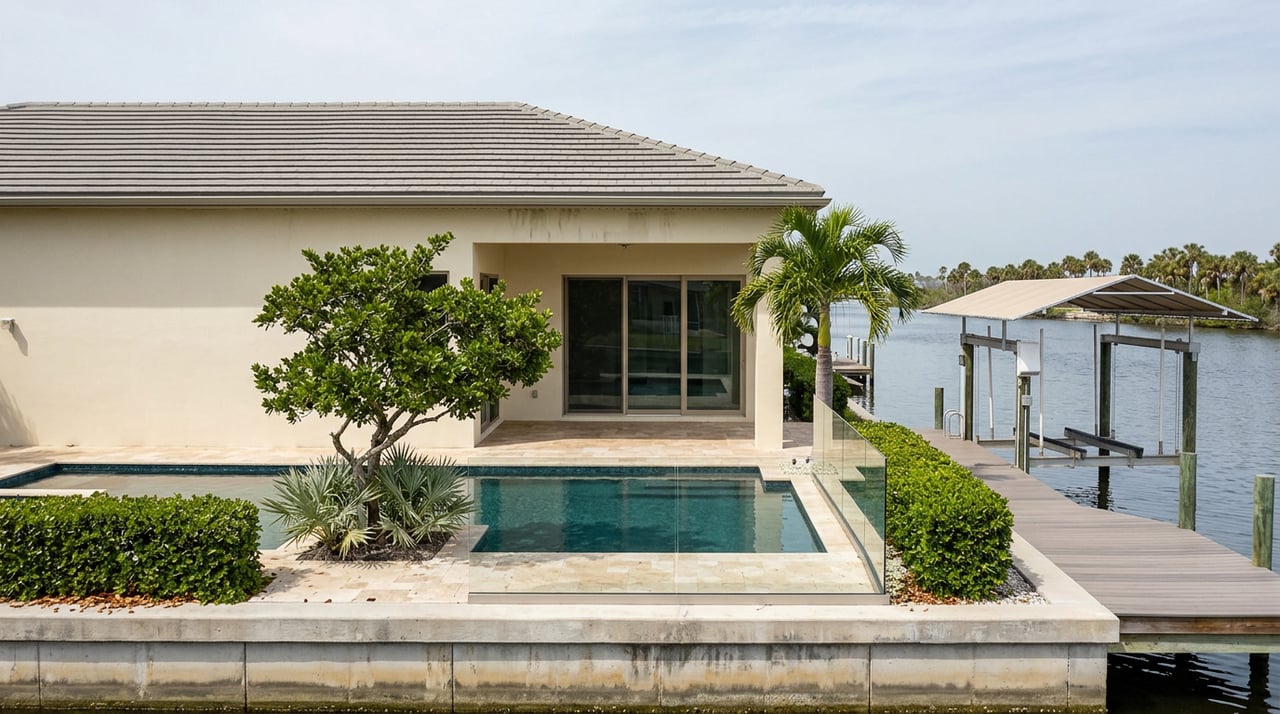
Picture two canal homes in Southwest Cape Coral, a block apart, listed within a few thousand dollars of each other. Same builder, same year, same dock. One agent describes the water as "Gulf access with easy boating." The other says the same thing. On paper, they're twins.
What neither listing mentions is that for decades before the lock closed to navigation in April 2025, boats leaving that neighborhood had to wait their turn to pass through a lock before they ever reached open water. That lock is gone now. Whether the comp your agent pulled, or the price your seller is anchored to, reflects that fact depends entirely on when the data was collected.
The Three Tiers, and Where the South Spreader Used to Sit
Cape Coral's canal system sorts into three rough tiers. Direct Gulf access means no bridges and no locks between your dock and the Caloosahatchee River, which flows out to San Carlos Bay and the Gulf. Indirect access means the connection exists, but something sits in the way: a fixed bridge with limited clearance, or historically, a lock. Freshwater canals are landlocked entirely, fed by rain and groundwater, with no route to saltwater at all.
For decades, the canals behind the Chiquita Lock in Southwest Cape Coral, the network known as the South Spreader Waterway that serves the Cape Harbour and Tarpon Point area, fell into that middle tier. The water eventually reached the Gulf. Getting there meant queuing for a lock cycle first.
| Canal tier | What it means on the water | South Spreader canals near Cape Harbour |
|---|---|---|
| Direct Gulf access | No bridges, no locks, continuous route to the Caloosahatchee | Status as of June 2025 |
| Indirect Gulf access | Gulf-connected, but a fixed structure sits on the route | Status for decades before the lock's removal |
| Freshwater / landlocked | No saltwater or Gulf connection | A separate system entirely, unaffected by the lock |
What the Wait Actually Felt Like
Before the removal, the lock wasn't an abstraction. It was a daily calculation for anyone who lived behind it. One longtime boater told WINK News that after years of dealing with storm damage and limited access, she was simply "anxious to get out," describing herself as "pretty much stuck" in the months leading up to the lock's removal. That frustration, repeated across hundreds of households for the better part of forty years, is the reason the city eventually acted.
The Weeks That Changed the Map
The City of Cape Coral closed the Chiquita Lock to navigation on April 1, 2025, so crews could begin excavation, seawall removal, and dredging as part of the South Spreader Waterway Enhancement Project. The work included planting mangrove seedlings and installing oyster reef balls alongside the demolition, framed by the city as an effort to improve water quality and reduce the risk of manatee entrapment at the site.
The project finished ahead of its own schedule. According to Fish Tale Boats, which tracked the construction for its boating customers, the lock was officially removed as of June 17, 2025, about eleven weeks after the initial closure. What had been a structure controlling access for the entire South Spreader network was simply gone.
That's the mechanical change. The market change is less visible, and it's the one that matters if you're comparing neighborhoods right now.
Why the Listing Might Not Have Caught Up
A canal address doesn't relabel itself the day construction equipment leaves the water. MLS fields get updated when someone updates them. Comparable sales used for an appraisal or a listing price get pulled from whatever transactions closed most recently, and plenty of those transactions closed in 2024 or early 2025, back when the South Spreader still ran through a lock.
That creates a specific kind of gap. Real estate analyses commonly place a premium of $100,000 to $200,000 or more on direct Gulf access homes over comparable non-waterfront properties, with indirect access typically running $50,000 to $120,000 above the same baseline. Those ranges move with canal width, water depth at the dock, and current inventory, but the general spread between the two tiers has held for years. If a South Spreader property spent its entire pricing history as an indirect-access home and only crossed into direct-access territory in the middle of 2025, the comps a seller is using today may still be measuring against the wrong tier.
This cuts both ways. A seller in that footprint who prices off pre-2025 comps may be leaving money on the table. A buyer who accepts the listing description at face value, without asking what route the boat actually takes now, may be paying a direct-access premium for a property whose listing hasn't been reclassified, or may be underpaying for one that has quietly moved up a tier. Either way, the label on the listing is not proof. It's a starting point for a question.
The Argument Underneath the Upgrade
The lock's removal wasn't uncontested, and it's worth understanding why, because the same tension will shape how the city handles its remaining spreader infrastructure. Calusa Waterkeeper, a regional environmental advocacy group, has argued that the structure originally existed to manage stormwater runoff under a court-ordered consent decree, and that its removal was driven less by environmental necessity than by the property value gains expected for homeowners behind it. The group points to the earlier removal of the Ceitus Barrier in Cape Coral's Northwest Spreader system back in 2008 as a precedent worth watching, noting that Matlacha Pass downstream of that project has since been listed as an impaired water body.
None of this changes the boating math for a buyer today. It does mean the story behind the access upgrade is more complicated than "the city improved things for boaters," and a buyer who understands that context is better positioned to ask informed questions about any future changes to the city's spreader systems, rather than assuming the current configuration is permanent by default.
How to Verify Before You Write the Offer
If you're comparing Cape Coral canal properties right now, the access label on the listing sheet is the beginning of the conversation, not the end of it.
Ask for the specific route from the dock to the Caloosahatchee, not just the access category. Two addresses in the same general area can have meaningfully different paths, and the presence or absence of a fixed bridge along that route still matters even with the lock gone.
Ask when the comparable sales your agent or appraiser pulled actually closed. A comp from January 2025 was priced against a South Spreader network that still had a lock in it. A comp from this year was not.
If you're a boat owner, confirm bridge clearance along your exact path before assuming any South Spreader address works for your vessel. The lock's removal eliminated a chokepoint. It didn't rebuild the bridges on the rest of the network.
A Few Questions Worth Asking Early
Does this mean every canal in Southwest Cape Coral is now direct Gulf access? No. The removal affected the South Spreader network specifically, the canals that previously routed through the Chiquita Lock near Cape Harbour and Tarpon Point. Freshwater canals in the northern and eastern parts of the city were never connected to that system and are unaffected.
Did anything change for freshwater canal owners in North Cape Coral? Not from this project. Freshwater canals remain a separate, landlocked network fed by rain and stormwater, with no route to the Gulf regardless of what happened at Chiquita Lock.
Is there a risk the access could change again? The city's public materials frame the lock removal as part of a broader, multi-year environmental improvement program rather than a temporary measure, and no source indicates plans to reintroduce a similar structure at that site. Any future changes to the city's other spreader systems would be a separate decision, worth tracking if you own or are considering property tied to those networks.
If you're weighing a Cape Coral canal home against a comparable option in Fort Myers or elsewhere along the coast, the label on the listing sheet is only useful if it reflects the water as it exists today. That's the kind of detail that's easy to miss from a portal search and straightforward to verify with someone who tracks these changes as they happen.
If you want a second set of eyes on a specific address before you write an offer, or want to talk through how a canal's current status should factor into your search, Daniela Mitchell's team at Mitchell Properties & Salty Hook Homes is glad to walk through it with you. Schedule a consultation and bring the listing.